
An expedition to the inner world
Reached the top; but lost the path?
Around midlife, often just as a career or a marriage peaks, something shifts. Sometimes life forces it: a job ends, the children leave, the body sends its first warning. Sometimes it is quieter: a restlessness, a thinning joy, a sense that the mountain you spent decades climbing is not all it promised. Now, in the distance, shrouded in fog, rises a second summit, shaped by who you actually are rather than who you set out to be. Yet, the way is not straight and the path leads down before it goes up.
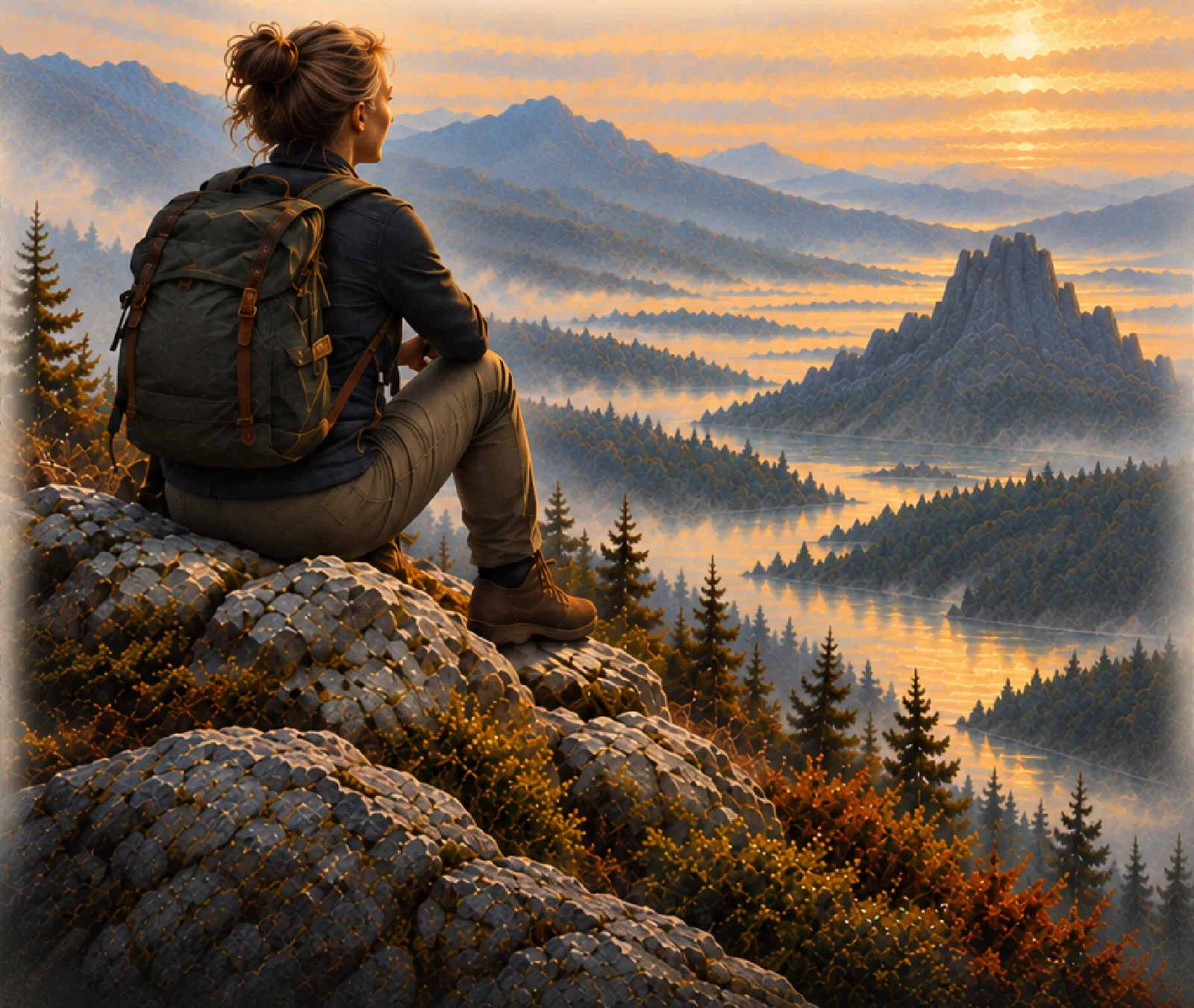
“Midway through the journey of life, I found myself in a dark wood, for the straight way was lost.”
Dante, Inferno
“You would not find the limits of the soul, though you traveled every road, so deep is its measure.”
Heraclitus
“Do not go outward; return into yourself. Truth dwells in the inner self.”
Augustine
“Does the road wind up-hill all the way? / Yes, to the very end. / Will the day’s journey take the whole long day? / From morn to night, my friend.”
Christina Rossetti, “Up-Hill”
“We’re not on our journey to save the world but to save ourselves. But in doing that you save the world… The influence of a vital person vitalizes.”
Joseph Campbell, The Power of Myth
The Two Summits
“The first peak is that of the Hero. The second is that of the Sage.”
Elders in many traditions agree on one thing: to keep growing in midlife, at some point we must turn journey inward to find our true purpose. Yet few of us are ever taught what it actually means to journey to the center of our being, how to make that crossing, or what we will find when we get there.
What Second Summit is
Second Summit is a practical map and method to undertake the inner journey of midlife. It is a six stage process envisioned as a journey from the first summit in life — where we have achieved what the ego asked of us — to the Second summit where we discover and become aligned to our deeper purpose in life. It is a process of expanding consciousness by unpacking unconscious contents and integrating it with our conscious perspectives to achieve wholeness.
The process is grounded in depth psychology approaches, above all Carl Jung’s work on individuation, and in older teachings from around the world that have long understood that the great transitions of life require an expansion of consciousness. A Jungian analyst would introduce you to many of these ideas and practices over years of a formal analysis. But open-ended analysis has a difficulty: it is hard to envision what the whole process looks like, and once you are in it, hard to tell where you are. Second Summit makes it easier to understand and navigate.
What is individuation?
Individuation is Carl Jung’s name for the process of becoming who you actually are. At midlife, the conscious personality — the ego — comes to terms with what it has pushed aside in order to succeed: rejected traits, unlived possibilities, the deeper self beneath the roles we play in public. The aim is to bring these lost parts back into awareness, so that you can live as a whole person rather than only the part that learned to fit in.
Individuation is a life-long process, but Second Summit focuses on that “middle passage” where the need first presents itself (anywhere from age 30 to 55) and focuses on the specific goal of helping uncover a person’s their vocational path… namely their unique gifts and abilities — which Michael Meade called the Inner Genius — which are both inherent but also shaped by the first half of life. After that vocational path becomes clear, the person can continue on their own.
Why a map?
I created Second Summit to make the initial stretch of that process, the midlife passage, legible. The Second Summit journey is divided into six stages, each building on the stage before, with landmarks along the way that show where you are. Myth, psychology and the world’s initiation traditions have each charted parts of this ground. Second Summit draws those maps into a single landscape, and gives you a guide who has walked it and knows the way. See the map.
How does Second Summit use the Enneagram of Personality?
The Enneagram reached the West through G.I. Gurdjieff, who taught the nine-pointed map in the early twentieth century and claimed for it an ancient origin that has never truly been traced. Its use as a map of personality is far more recent: Oscar Ichazo and Claudio Naranjo developed it in the 1960s and 70s, and Don Riso and Russ Hudson refined it further. Each of the nine “Enneatypes” describes a characteristic way of adapting to the world: what we learned to lean on, and what we learned to repress or leave behind.
The Enneagram’s particular value is more than a typology system. The lines connecting the nine stations suggest specific directions in which each type tends to grow, and the qualities it most needs to develop to achieve wholeness. In Second Summit, the 9 Enneagram types represent 9 distinct paths through the six stages of the Journey. Understanding the Travelers specific Enneatype helps the Guide understand their natural tendencies and guides the choice of practices: some that may come naturally, and others that balance those tendencies and draw out what has gone undeveloped.
What Second Summit is not
It isn’t therapy, religion or coaching, and it isn’t a wilderness program. Second Summit is a map and a method to help you undertake the inner exploration of the second half of life — referred to by Jungian author and analyst James Hollis as “the middle passage,” with a guide who has made the journey. It combines Jung’s psychology, the initiation traditions of West Africa, the teachings of the wisdom schools, and the myths and epic poems that have charted this passage for millennia.
What will I gain from this experience?
Above all, Second Summit will help you discern your unique vocation: the contribution that is yours alone to make, and the way of living in which you are most at home in the world. Along the way, most Travelers discover they are not one singular “I” but a whole cast of characters. They learn the language of the deep psyche: its symbols, practices and rituals. Many find the world growing larger, stranger and more enchanted. Behind old wounds, they often find their deepest gifts. In a few words: they find meaning.
They also leave with useful things: a map of their own crossing, drawn from their own dreams and reflections; their personal myth; and practices for the rest of life’s journey.
The first conversation is free
It’s for both of us to see whether the fit is right.
Begin